Where Ya’ From?
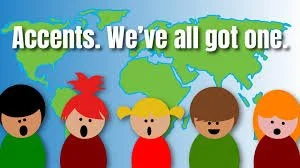
Oh, the richness and diversity of people. Culture, tradition, religion, and physical appearance are all stirred into the melting pot of our country, “from sea to shining sea.” One aspect sprinkled into this mix might be the subtle variations in how people speak and what they say.
San Francisco, LA, Chicago, and NYC are popular destinations for international travelers, as well as people moving from abroad to our nation. Those of us who live in big cities hear the voices of these tourists and immigrants more often than people in smaller towns.
I often eavesdrop on conversations, especially in airports. Besides the look of a person from a foreign country, I am drawn to the sound of their voice. I like to guess an individual’s country of origin. There are definite nuances of tone, rhythm, cadence, and timbre in different languages. Think back to language classes in high school or college, the lyrical French, guttural German, melodic Spanish, and vowel-rich Asian languages.
Television is a good place to hear an Irish lilt, a Scottish brogue, or an English Cockney accent. Voice coaches teach actors specific accents, regional dialects, vocal patterns, and oral posture. Meryl Streep and Gary Oldman are just a few of the actors who have mastered the art of speaking different dialects. Whether flipping from American to English or Scottish to Australian, it is a technical art to be admired.
It’s fun to hear regional accents. These speech patterns oftentimes originate within the immigrants’ settlements or develop from their contacts in the United States.
I grew up in western Pennsylvania and can pick out a person speaking this local accent eight out of ten times (a big exaggeration) on television. Hearing a person pronounce certain words with the last syllable being “ple” as in “people, example,” or with words like “tire, fire, iron” merging into a relaxed one syllable, I will search online, and sure enough, they are near my hometown, particularly in the Pittsburgh area. Case in point: Bill Cowher, a sports analyst and commentator for CBS Sports, has a regional accent, and I nailed it! “Pittsburghese” has a nasal quality, blended syllables, an even pitch, and some vowel shifts. Local sayings in western PA are “yinz, crick, warsh, don’t be so nebby, and let’s redd up,” all influences from Scotch-Irish, German, Eastern European, and possibly Swiss (Amish).
Many can spot a Boston accent a mile away. The rhotic (R, from the Greek letter, rho) accent focuses on the consonant “r” and is pronounced in all word endings and before consonants. Mark Wahlberg the actor, doesn’t have it. So, a typical Boston or non-rhotic accent would be “Pahk the cah,” and “Where’s ya mothah?” Just when we think we can identify a Bostonian accent, someone might throw in an extra “r” and say, “the idear of it!” First, the Irish, then the Italians, Russians, and Eastern European Jews settled into this area, so blame all the confusion on them!
“Hey, ‘wassup’? Can I get a glass of ‘waw-tah’ with a ‘sangwich’ or a ‘bagel with a schmear’?” Of course, you’re in New York City or ‘da’ Bronx! The lingo is a mix of multiple languages, including Puerto Rican/Latino, Italian, Irish, and Yiddish. Big Apple slang features rapid-fire phrasing like “Yaheardme,” strong consonants, and “r” sounds that are dropped or softened. A few indicative words and phrases to this city are: bodega, OD (over the top), and Deadass (seriously, truly), I’m not joking.
The midwestern states, roughly twelve, are lumped under the umbrella of having the General American English (GenAm) accent. Although opinions are subjective, it is generally considered the most neutral of all American accents. People in the states of Iowa, Kansas, Nebraska, Michigan, and parts of Ohio, Indiana, and Illinois have this nondescript way of talking. I beg to differ. My friends from the Chicago area have a distinctive, drawn-out way of saying a flat-sounding “a” in certain words.
The African American English (AAE) or African American Vernacular English (AAVE, Ebonics) originated in the 17th century with contact between the West African languages and the British English during American slavery. In the 18th century, the Gullah (Geechee) language took root in the lower coastal regions of South Carolina and Georgia.
Often thought of as the friendliest of accents, the southern pronunciation can be expressed as a drawl, low country, Appalachian, Cajun, or country twang.
https://www.youtube.com/watch?v=UcxByX6rh24
When delving into the nuances of language, I heard one vocal coach say, “Accent is identity.” How we talk and what we say help define our individuality. It makes us who we are. By speaking and listening to others, we realize that this uniqueness is part of the wonderful diversity of the United States of America.
Are you in tune, literally, to the different ways people speak? Do you think you have a distinct accent? What accents do you like or dislike? What words or sayings define a state or region for you?
Bit by bit, that’s all she wrote…