Occam’s Razor
I should have been a detective. As a child, I loved reading Nancy Drew books, playing the board game Clue, and watching the legal TV drama, Perry Mason. Later, my attention turned to Jessica Fletcher’s Murder She Wrote and House, the medical show on solving perplexing cases. Now, my husband and I watch TV crime series where there is a mystery or murder to solve. While watching, I inevitably will blurt out my “whodunit” guesses, as my husband huffs and says, “Shhh, just watch the show!” I love the challenge of examining the details, delving into the clues, and taking in the whole picture before coming up with that eureka moment.
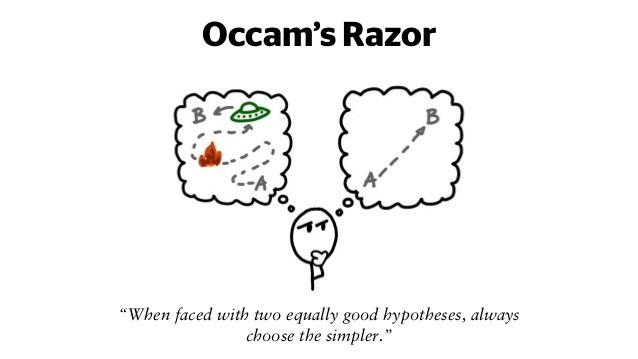
Which brings me to Occam’s razor. Over the years, I became aware of the term in my favorite shows and even as an answer on Jeopardy. Occam’s razor is the problem-solving principle that assumes that the simplest explanation is usually the best one. It requires the fewest assumptions when multiple explanations are equally valid. This term is attributed to William of Ockam—a 14th century English philosopher and theologian. It further traces as far back as Aristotle (384-322 BC) on the philosophy of simplicity. The “razor” refers to the shaving off or cutting the clutter of unnecessary assumptions when evaluating competing explanations.
The Law of Parsimony is another term related to Occam’s razor. “Parsimony” means being unwilling to spend money or extreme stinginess. In science and philosophy, this law refers to the avoidance of unnecessary assumptions; use frugality with your explanations.
In medical school, students are taught the Hoofbeat Analogy. When you hear the clop, clop, clop of hoofbeats, what animals do you hear? “Think horses, not zebras.” When presented with a sick patient, start with the most common scenario rather than a rare, complex one. For example, a cough and chills might present as a cold or flu rather than pneumonia or RSV. Assemble and review all the symptoms and common causes to make an initial diagnosis.
In criminal investigations, detectives first identify the most likely suspects by focusing on motive and direct contact with the victim. Family members and acquaintances are normally first in line for questioning. It can be a matter of common sense to look at those who knew the victim. Although it is not always the correct assumption in solving a case, it is a good starting point.
In scientific research, oversimplification can bring forth skepticism, particularly with the complexities of real-world phenomena. Occam’s razor might best be coupled with other theories and models so that critical details and nuances are not missed. Our world and beyond are extremely complicated entities.
How does the concept of Occam’s razor apply to our daily living? Some scenarios:
I am about to hop in the car and notice a flat rear tire.
Assumption: I must have run over a nail, not that a disgruntled person slashed my tire.
My car won’t start.
Assumption: I have a dead battery/loose wire, not a thief stole my battery.
I can’t find my keys.
Assumption: I misplaced them, not someone took them.
A student did not turn in homework.
Assumption: The student didn’t finish the assignment, not that the dog ate it.
In researching Occam’s razor, I discovered a few movies that follow this philosophy. If you are a movie buff who likes plot twists, you might watch or revisit:
Contact (1997) – coexistence of science and religion
The Prestige (2006) – rivalry of 19th century magicians
The Dark Knight (2008) – Gotham City characters fighting crime
Pulp Fiction (1994) – dark, non-linear crime drama
Sherlock Holmes (2009) – Sherlock and Watson enter the strange, occult world
and the one I’m going to rewatch is Gone Girl (2014) – psychological thriller of deception
The following are some examples, focusing on a major issue and the simplest possible solution. It is a good exercise for all of us to think about. Pick a big issue of concern and try thinking of the most straightforward result.
The gun violence rate drops when the sale and purchase of guns are restricted.
Global wars can be scaled back by reducing each country’s defense budget.
Childhood obesity rates decline with less screen time, better nutrition, and more exercise.
Measles is eradicated when everyone gets vaccinated.
Mental health improves with increased positive social connections.
Many of us unconsciously follow the simple over the complex assumptions. Whether it be Occam’s razor, the Law of Parsimony, or the Hoofbeat Analogy, we might become consciously aware next time when deducing a situation. Whether it be in our daily lives or in big world issues, look at the simplest explanation for finding the solution. It might have limitations and does not guarantee the correct answer, but it is the very best place to start.
Bit by bit, that’s all she wrote…