From Circle Time to Compromise
Are you exhausted listening to the nightly news, particularly issues in the political arena? It’s an unsettling circus of bullying, finger-pointing, and name-calling. Can people agree to disagree and move forward? Some politicians could use a refresher course in the forgotten lessons learned from childhood. They need to revisit good manners like the polite ‘please-and-thank you’ ones that lead to the character-building traits of integrity, responsibility, and respect.
Sharing is an early life skill that is essential for building cooperation, developing empathy, and engaging in healthy social interactions. Parents, daycare providers, and teachers guide children to look beyond themselves to develop this skill. Disputes on the playground can be precursors for developing effective communication and collaboration later in life. Whether it’s playing hopscotch, tetherball, or going down the slide, children need to work out who goes first, second, and so on. Some children may emerge as leaders, diffusing conflict in the playground arena. Could they become successful negotiators in adulthood?
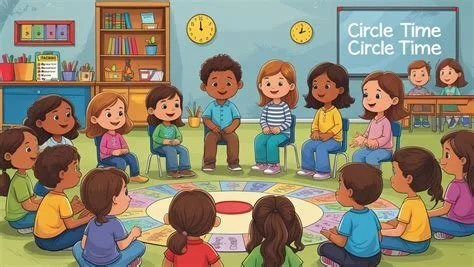
Remember circle time? At the beginning of the school day, the teacher gathers the students to sit in a circle. There is no one in front and no one behind; all are equal. This is an opportunity for the teacher to set the morning’s tone and bring up what’s expected throughout the day. Circle time would be remiss without a little show and tell, where a child can share, where a child can shine. With the whole group in attention, taking turns, active listening, and courtesy are skills developed during this pivotal part of the school day.
With cooperation and trust, children may further enhance this concept of sharing through team sports, group school projects, and classroom discussions. The sharing of physical skill sets, thoughts, and ideas is highlighted, all fostering a sense of belonging and connection.
Some grownups experience and test a higher level of common ground. Here, different viewpoints enter the picture. How does one resolve conflict? With listening, patience, and taking turns as in circle time, people hopefully engage in civil discussions, steering towards a reachable agreement. That’s called negotiation. People probably won’t get 100% of what they want but both parties can move forward with an agreed-upon outcome. Globally, this is diplomacy. Often, discussions between nations become heated, as we witness today. A go-between or mediator who is skilled at negotiation (maybe a former playground leader) might ease the process along. Ultimately, the goal is an acceptable compromise.
The art of compromise should be a required class taught in every high school in America. Today, this expertise is grossly lacking in our country. Instead, many people are taught “never settle. It’s my way or the highway. I am the winner; you are a loser.” Well, I’m in the camp of always looking for a win-win situation. Obviously, as a nation, we want to uphold our integrity and values, as well as observe any safety, legal, and professional boundaries. But I think we are at a standstill in today’s political arena. There seems to be no crossing the proverbial line for reaching a mutually acceptable solution.
As AI eloquently states, “The art of compromise is the delicate process of settling differences through mutual concessions, where each party adjusts its demands to reach a mutually beneficial agreement. Far from just “giving in,” effective compromise is a collaborative exercise that requires high emotional intelligence, active listening, and a willingness to prioritize the health of a relationship or project over individual “wins.” It doesn’t sound like our government officials have this skill, does it?
Some naysayers think compromise is mediocrity; it eats away at self-respect and passion. If this is the case, what is the alternative, to keep “your soul” intact and build up hostility in a stalemate? To stress again key principles for effective compromise,
· identify non-negotiable values while focusing on common goals,
· have a willingness to hear the other party’s perspective with understanding, not surrendering,
· and, ultimately, reach mutual concessions to create a balanced solution.
A “Two Ovals” approach is a good exercise in compromise, often recommended in couples therapy and possibly in a country’s negotiations as well.
· Inner Circle (inflexible area): List non-negotiable, core needs and values.
· Outer Circle (flexible area): Identify areas willing to make concessions.
· Find Middle Ground: Compare ovals with other(s) to find a solution that respects all sets of core needs.
To effectively move forward and get things accomplished, every newly elected official might benefit from a geometry lesson of sitting down in circle time and passing the course of Two Ovals of Compromise.
Being one constituent, I would cast my vote in favor of that requirement! What do you say, yay or nay?
Bit by bit, that’s all she wrote…