AI, Friend or Foe?
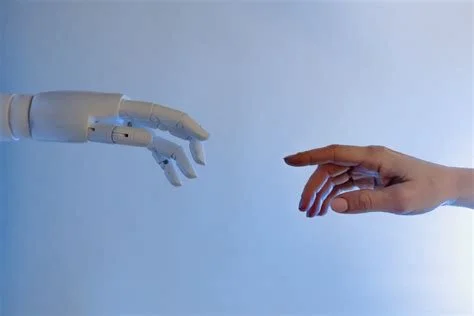
Is AI a friend or foe? I’m guessing the answer teeters depending on whom you ask. I’m what one might call “old-school,” as I don’t readily embrace tech advancements. I am definitely a straggler for getting on the technology bandwagon. I don’t have Venmo or Zelle*, but I pay bills with a paper check sent by snail mail with a stamp and envelope. I take morning walks without my iPhone in hand or a smart watch, counting a recommended 10,000 steps. I don’t own ear buds or use Spotify for music, don’t talk with Bluetooth, or really understand the cloud. I do, however, enthusiastically embrace FaceTime, GPS, Google, and most recently, Search Assist and AI Overview on my computer. I guess I’m a teeter-totter!
So, what is artificial intelligence (AI)? Through Search Assist, artificial intelligence refers to computer systems that can perform tasks typically requiring human intelligence, such as learning, reasoning, and problem-solving. AI can analyze data, learn from experiences, and make decisions autonomously. I find this scary. I’m leery and not ready for it.
This past June, some friends and I participated in a production called The Jury Experience. The audience was the jury and voted on certain aspects of the trial through a QR code on our phones. (There’s that technology creeping in again!) With live actors – a judge, prosecutor, defender, defendant, wife of the deceased, and a couple of audio depositions – the premise of the case was that a driverless taxi hit and killed a bicyclist on the side of the road. The defendant was the engineer who developed the technology for the car. At the beginning of the performance, the jury was given limited information and asked to vote on whether the defendant was guilty or not guilty. Out of approximately 200+ participants, 71% found the defendant not guilty. At the end of the trial, after digesting all the presented evidence and testimonies, we were asked to vote again. This time, 61% found him not guilty; I was one of the 10% who switched their votes to guilty. I figured that someone needed to be held responsible for the death. It’s a hard scenario to wrestle with, debate, and confidently conclude.
Currently, driverless cars are popping up all around the country. Have you seen any? Recently, while visiting Atlanta, I did a double-take at a red traffic light. I glanced over at the car next to us; there was no one in the driver’s seat. These cars are touted as statistically safer compared to humans driving cars. I’m all for progress, but I’m not getting into one, no matter how much data input is crammed into this technology. Eventually, will there be pilotless planes? Call me a skeptic, but I won’t be buying a ticket!
Today, AI is a big topic of conversation with teachers in school classrooms. Middle school and high schoolers are enticed to use AI to complete their projects and reports. How do teachers weed out the cheaters? AI can be a quick, easy, and lazy fix to turn in a paper. With young brains not fully developed, will adolescents exercise this organ to its full potential? Thoughtful human brains might take a backseat to regurgitated algorithms. I wonder if AI is dumbing down our society.
On a positive note, advanced technology may power breakthroughs in medicine and science. Could AI help discover cures for cancer, ALS, Parkinson’s, and Alzheimer’s? Climate change, hunger, and space exploration are a few more issues that AI could hopefully assist in finding solutions.
What happens to the creative sector of actors, authors, musicians, and artists? Will we be able to discern a real person on screen versus a bot? Who or what pens that next best seller? Is it a musical score written by a composer or instrumental programmed data? Is an individual with a paintbrush creating a piece of art or a machine with no heart or emotion?
Are future civilizations giving up humanity’s flaws, individuality, and diversity?
Many questions swirl with uncertain answers. Who manipulates AI and what data feeds it? Is truth becoming black and white with fewer gray areas? Does AI have the capacity to brainwash and alter morality and ethics? Will people rely on their own thoughts and values by rigorously questioning AI, or will they just become accepting puppets?
A friend recently recommended the following novels on the AI subject that might be of interest:
The Proving Ground by Michael Connelly (a Lincoln Lawyer novel)
Culpability by Bruce Holsinger
Am I overreacting with this Orwellian thinking? Maybe. Just remember that the horrors of the Holocaust did not unfold in a day; it was years in the making. See Bill Maher’s conversation on AI with Tristan Harris, co-founder of The Center for Humane Technology:
https://www.youtube.com/watch?v=qkGUgtWWBVg
I’m a little frightened for the generations to come! Beware and be aware. What are your thoughts on AI, and what do you think lies ahead for us?
*Update: I recently added Zelle to my bank app. (I’m not a total dinosaur!)
Bit by bit, that’s all she wrote…